continued from Chapter 1
Calypso has come to be known as the national music of Trinidad and Tobago. The exact origin of the word is not known, but throughout the years, several theories have been established. Amongst these theories, the following are considered the most acceptable:
1. It has come from the Carib word “carieto”
meaning a joyous song.
2. It is a derivative of the word “carousseaux” which is a French patois
recreation of a word meaning a drinking party or festivity.
3. The West African term “kaiso” which itself is a corruption of a word which
carries a similar meaning to the word “bravo” (Warner :1982.7).
The “Calypso” is a topical song (usually sung extempore), which can either be
satirical or flattering. The exact date of its emergence in Trinbagonian society
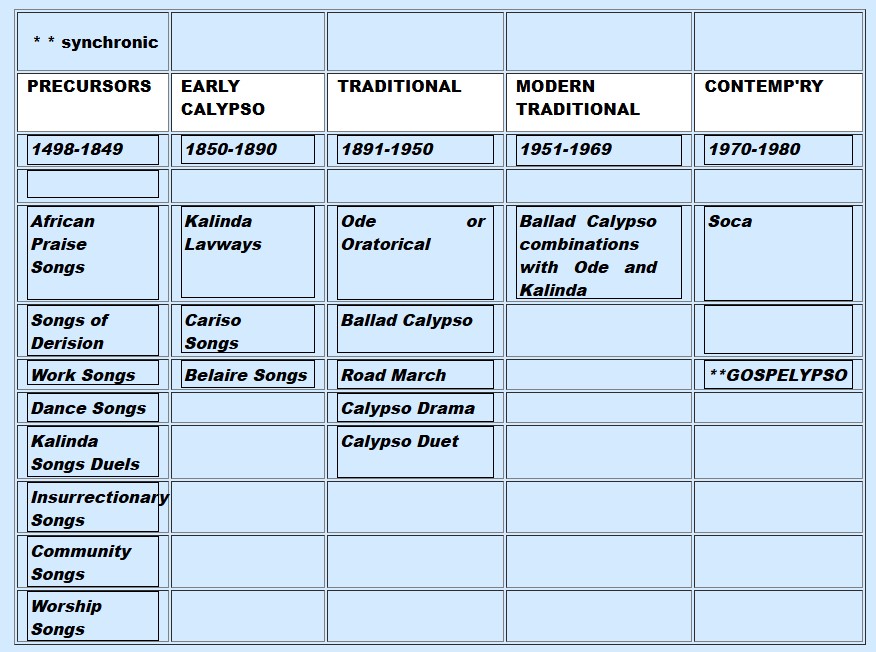
is not known, but Selwyn Ayoung in his thesis entitled “Soca Fever”, maps out a
diachronic profile of the calypso artform.
Because Gospelypso has emerged out of Calypso, it can be considered as a sub-set
of Calypso and as such the profile shows all the constituents of Calypso which
have likewise influenced this artform.
The history of Calypso as it is presented in Mr. Ayoung’s profile below, is important, as it clearly shows where Gospelypso fits into the
diachronic history of Calypso.