ACKNOWLEDGMENTS.
Thanks must be given to the following persons for their invaluable contributions to this thesis; George Livingstone, Yvette Livingstone, Reverend Lealand Henry, Noel Richards, Earl Phillips, Francis Warner, J. Errol Lewis, Father Garfield Rochard and Mervyn Williams.
Your willingness to support will never be forgotten.
Rochelle Livingstone
(Arts and General Studies - U.W.I. 1995)
“Gospelypso:
is taking a gospel message,
and putting it in we language
so that locals could get the message, all in the village,
Gospelypso:
is bringing de Bible
to ordinary simple people
Oh , Oh,
Dat is Gospelypso!”
Noel Richards “The Professor”
This thesis will explore the relatively new genre of music known as Gospelypso. For a long time, I have been concerned with the poor reception which this and other local artforms receive from the local listening audience. I see this thesis as an opportunity to dispel some of the misconceptions which are grounded in ignorance of the facts.
It is my hope that an understanding of the ideas which are put forward in this dissertation would lead to a willingness to accept Gospelypso as our own to nurture and to develop.
[In 2025 Video links to the Gospelypsoes of the pioneers and some additional images were added to this document]
Combo
A combination of musicians, usually used to refer to a combination of guitarists.
Exodus
A movement of a crowd away from a particular place( has a religious connotation as it is often used to refer to the movement of the Israelites out of Egypt.)
Heckling
The art of skillfully teasing a person, usually on a particular physical trait or characteristic.
Massa
A derivative of the word “Master” ( used by the Blacks in the days of slavery to refer to their owners. )
Spooge
A musical form coming out of Barbados; it is a combination of Calypso and Barbados folk music.
Stalling
A Creole word which refers to any superficial action which is designed to deliberately waste time while waiting for the significant event.
Trinbagonian
The combination of the words Trinidad and Tobago - used to refer to a native of these islands.
In dealing with this subject matter, I have chosen to use concepts which are drawn from Ethnomusicology, Religion, Folklore and Anthropology.
As such, I have examined the following theories and have applied them to this area of study in the hope that it will add clarity to the subject matter.
1.Toelken: The Spectrum of Dynamics(Toelken: 1970)
2.Merriam: Uses and Functions of Music(Merriam: 1964)
3.Schreiter: Constructing Local Theologies(Schreiter: 1985)
4. Herskovits: Enculturation and Culture Shock(Herskovits: 1966)
Due to the fact that there is almost no written material on this subject matter (Gospelypso) , the information which is directly related to the artform: matters of a historical nature, performance practices and repertoires, were all gleaned from personal interviews. A thorough questionnaire was prepared for the informants. Lyrical texts were transcribed from listening to recordings of the songs and in one case from the recollection of the composer himself.
The Seventies marked a period of socio-political unrest in the islands of Trinidad and Tobago. The Black Power Movement was strongly influencing the spirit of the nation at that time. This movement is pertinent not only to the rise of Gospelypso, but to almost every issue in the island at that time. As with most societies, the cords of religion, politics, literature...oral and written, education and music were inextricably intertwined. It is therefore necessary that some background to the socio-political climate be given.
The post-emancipation society of Trinidad presented a picture of deep contrasts. A conflicting value system had been established by the presence of both old and new ideologies. In the minds of the people, the Roman Catholic Church was the Traditional church of the island. A nationalistic spirit was emerging from all ethnic groups and finally, groups of people were establishing their own sense of identity. This identity was not always in keeping with the tradition of conservatism which had been established by the Roman Catholic and Anglican churches of the area. The Black Power uprisings were the manifestations of the stripping away of the vestiges of traditionalism.
The fact that the Roman Catholic churches had been established by the Capitulation as the “head church” led the Evangelical “non-conformist” churches to take their cues from these more “established churches”.
 Influenced by the Black Power activists, many organizations emerged. The National Alliance for Reconstruction ( The political party which held office during the five year period: 1986-1991) formed some of its ideology around the views of the activists. Other organizations such as Junior Achievement and The Caribbean Nazarene Theological College also came into being during this time. The steelpan gained recognition as it was something local and could be considered as a “black man’s invention” .The Express newspaper dated the 2nd March 1970 quotes the leaders of the Steelband Association as saying that they felt they could not “divorce itself (themselves) or disassociate itself (themselves) from the Black Power Movement” ( Express Newspaper, 2nd March 1970.1)
There was great clamour about the role of the Roman Catholic Church in the society. The Black Power activists did not see the relevance of the church to the black man in the context of local culture. Their sentiments were expressed in this way: “The Roman Catholic Church is white; Jesus is white; Mary is white; all the apostles (except perhaps Judas) were white, all the angels and saints (save a few added hastily the other day) were white. (Express Newspaper, 7th March 1970).
These strong views were backed up by actions. During one protest, the marchers for whatever primary reason, entered into The Immaculate Conception Roman Catholic Cathedral (Port of Spain) and placed a red cloth over the statue of the Virgin Mary. In the eyes of the law, such an act may be termed “a violent action”, nevertheless charges were not brought up against them and they were not prosecuted. The protesters were against what could be termed intellectual pillage of impressionable blind minds. One headline read as follows: “Catholic episode shows need for change” (Express Newspaper, 7th March 1970). Father Boyd Reid of the Roman Catholic clergy admitted that the church did in fact perpetuate “white domination”. One question posed by Father Boyd Reid reads “Is the Roman Catholic Church in our society in any way a structure of white domination?” he continues, “I think in some ways that it is. The Catholic Church came to the West Indies as an integral part of the colonization process. It brought with it concepts and symbols that had been forged in the development of European civilization. It has continued to depend almost entirely on Europe for these concepts and symbols over the years.”
It is necessary also for the reader to note that it was in the seventies that the Archdiocese met and formed a committee to produce a book
of local songs called “Let The People Sing”.
In 1972 and 1973, local songs were already composed for use in the Catholic Folk Mass, showing a trend 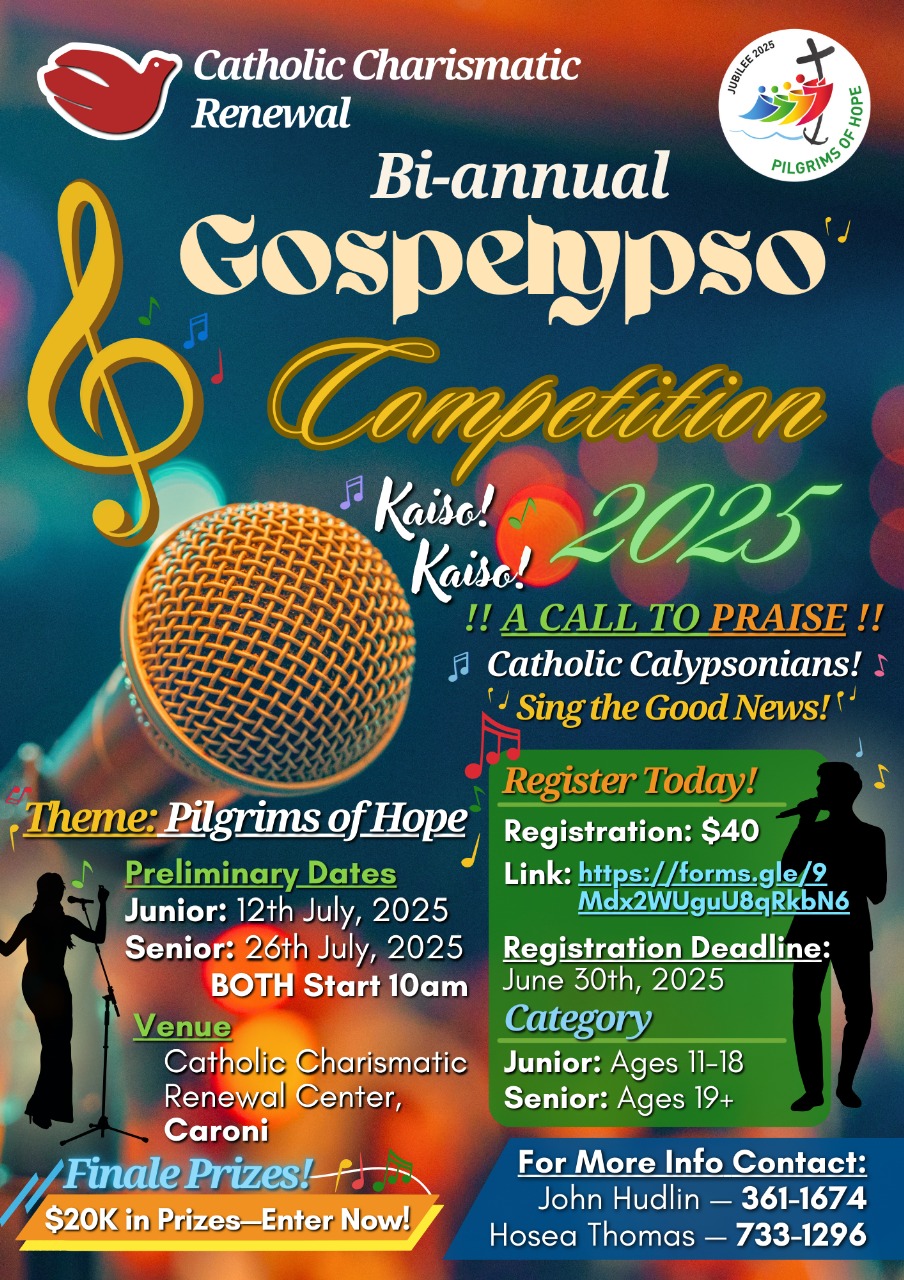 towards the use of indigenous material in a sacred context. This may very well have been the Catholic Church’s response to this cry for contextualisation of the religion. They recognized that efforts towards making the religion more applicable to the locals was indeed necessary.
It is in this vein that Gospelypso emerges. The Catholic Church has set the precedent and the climate was right for the emergence of Gospelypso. Further reading would reveal that the first Gospelypso rally was held in 1972. It may be true that many of the pioneers of Gospelypso and its followers are reluctant to admit that the Black Power Movement could have had anything at all to do with the emergence of Gospelypso, however such a denial is an attempt to extract one process and have it stand in historical isolation. We must never be guilty of underestimating the impact of one process upon the other within a social context.